
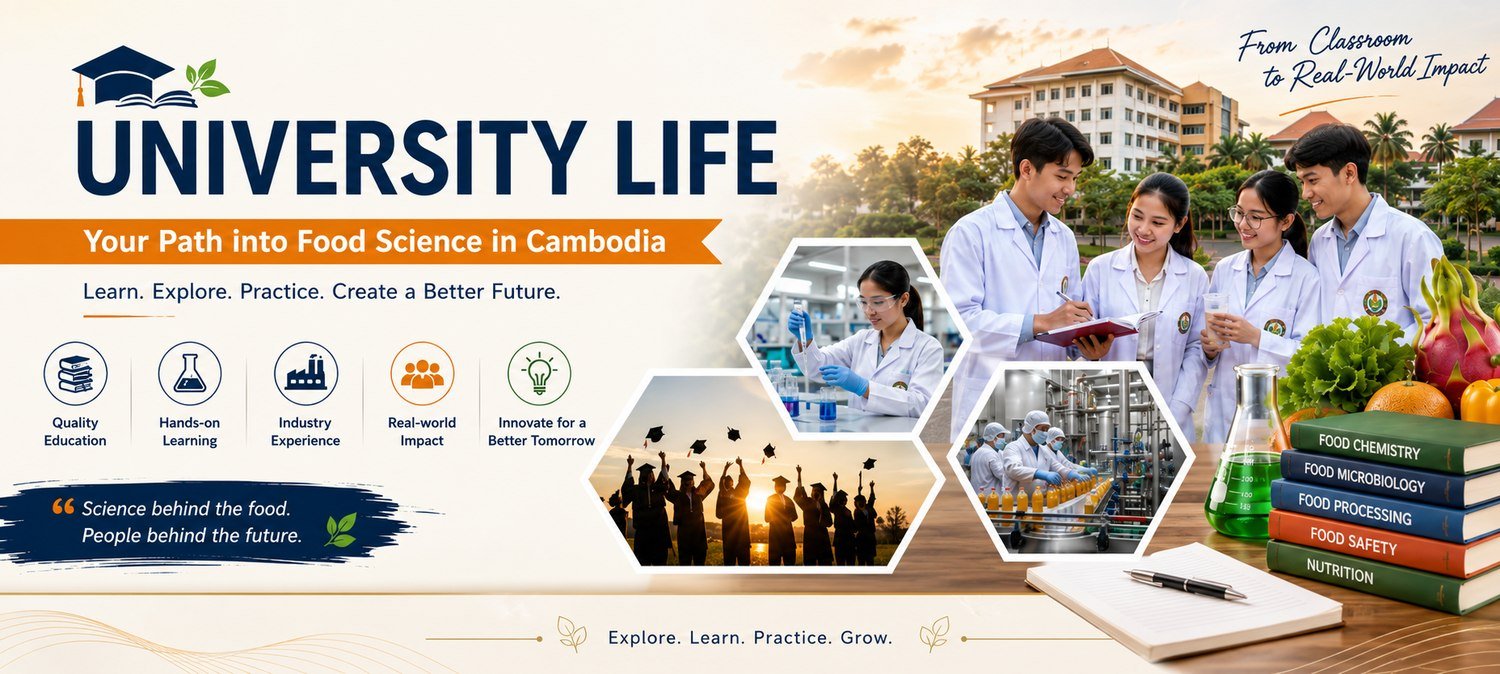
Helping Future Food Scientists Build Their Career
“If I want to become a food scientist, where should I study, what should I expect, and how can I prepare for a successful career?”
Choosing a university is an important decision, but becoming a food scientist involves much more than selecting a school or earning a degree. It means learning how science can be used to make food safer, improve quality, reduce waste, extend shelf-life, and transform Cambodian agricultural products into valuable foods for local and international markets.
This guide is designed to help high school students, university students, and recent graduates understand what studying Food Science is really like. It provides practical guidance on choosing a study program, preparing for university, succeeding in laboratory work, finding internships, and developing the skills needed for a professional career.
1. Is Food Science Right for You?
Many Cambodian students have never heard of food science before university. In simple terms, Food Science is the study of what food is made of, how it changes, why it spoils, how it can be processed, and how its safety and quality can be controlled.
It is not the same as cooking, although understanding food preparation can be useful. Food Science combines several disciplines, including:
- Chemistry
- Biology and microbiology
- Nutrition
- Engineering
- Quality assurance
- Statistics
- Sensory science
- Product development
- Food-safety management
A food scientist may investigate why a beverage separates, determine whether a sauce is microbiologically safe, develop a new snack, evaluate the shelf-life of a product, improve a factory process, or ensure that a food label is accurate.
Food Science may be suitable for you when you are curious about questions such as:
Why does milk spoil? How does pasteurization make food safer? Why does fruit change color during processing? How can food remain stable at room temperature? What causes a product to lose flavor? How can local agricultural materials be transformed into higher-value products?
You do not need to know all the answers before entering university. You need curiosity, a willingness to learn, and the patience to solve problems carefully.
What does a food scientist do?
Food scientists develop new products, improve recipes and processing methods, test quality and safety in the laboratory, extend shelf-life, and make sure what reaches the consumer is safe and consistent. They work where science meets everyday food.
Food scientist vs food technologist
The two roles overlap. In general, a food scientist focuses more on the underlying science — why food behaves the way it does — while a food technologist focuses on applying that science in production and processing. In many Cambodian companies, one person often does both.
2. Where Can You Study Food-Related Fields in Cambodia?
Several Cambodian institutions provide education related to Food Science, Food Technology, agro-industry, food processing, nutrition, biotechnology, and engineering.
This guide is not intended to rank universities. Each institution has its own educational approach, strengths, requirements, facilities, and areas of specialization. Students should compare the curriculum, visit the campus when possible, speak with current students, and confirm the latest admission information directly with each institution.
Institute of Technology of Cambodia
The Institute of Technology of Cambodia, commonly known as ITC or “Techno,” offers programs that combine Food Technology with Chemical Engineering.
Its official academic information lists associate and engineering programs covering areas such as food chemistry, unit operations, food technology, biotechnology, microbiology, quality and food safety, management, internships, and thesis writing. ITC also offers graduate study related to agro-industry.
This pathway may be appropriate for students who are interested in:
- Food-processing technology
- Engineering calculations
- Factory and process design
- Food chemistry
- Food microbiology
- Quality assurance
- Research and product development
Because of its engineering orientation, students should be prepared to study mathematics, chemistry, physics, process operations, and technical problem-solving alongside food-specific subjects.
Students who enjoy understanding both the product and the production process may find this combination valuable.
Royal University of Agriculture — Chamkar Daung
The Royal University of Agriculture, commonly known as the agricultural university at Chamkar Daung, provides education across agriculture, agro-industry, agricultural engineering, food systems, and related fields.
Its academic structure includes a Faculty of Agro-Industry. The university is located in Chamkar Daung, Dangkor, Phnom Penh.
This environment may suit students who are interested in the connection between:
- Agricultural production and food processing
- Raw-material quality
- Postharvest handling
- Agro-industry
- Agribusiness
- Sustainable food systems
Studying food in an agricultural university can help students understand the entire value chain—from farms and raw materials to processing.
RUA also offers Academic Graduate Programs, including Food Science, for students who wish to continue to the master’s level.
Prek Leap National Institute of Agriculture
The Prek Leap National Institute of Agriculture offers agriculture-oriented programs at different academic levels.
Its official bachelor’s program information lists Food Processing and Nutrition and Health among its study areas. The bachelor’s program is described as a four-year program that includes foundational subjects, technical study, practical activities, visits to companies and production facilities, and a final research thesis. Its associate program also lists Food Processing and Nutrition and Health among the available fields.
This may be a suitable pathway for students interested in:
- Practical food processing
- Agricultural products
- Community-level production
- Nutrition
- Small-scale agro-industry
- Rural enterprise
- Applied agricultural education
The institute’s approach may appeal to students who want practical exposure and a strong connection to agriculture, communities, and primary production.
Royal University of Phnom Penh
The Royal University of Phnom Penh offers a bachelor’s program in Food Technology Engineering through its Department of Bio-Engineering.
According to the official program information, the curriculum includes analytical chemistry, microbiology, food processing, food chemistry, food engineering, preservation, packaging, sensory evaluation, product development, food law, sanitation, and quality assurance. The program also includes internship and final-project or thesis pathways.
This pathway may be suitable for students interested in:
- Food technology
- Bio-engineering
- Laboratory analysis
- Product development
- Quality assurance and quality control
- Biotechnology
- Research and industry training
RUPP’s broader bio-engineering environment may also be attractive to students who want to understand how biological science, engineering, and food technology connect.

Is the program mainly scientific, engineering-based, agricultural, or business-oriented?
An engineering program may include more mathematics, physics, unit operations, and process design.
An agriculture-based program may give more attention to crops, livestock, raw materials, postharvest systems, and rural production.
A food-science program may focus more strongly on composition, processing, microbiology, quality, safety, and product development.
None of these approaches is automatically better. The right choice depends on your interests.
How much practical work is included?
Food Science cannot be learned entirely from lectures.
Ask whether students have opportunities to:
- Conduct laboratory experiments
- Operate processing equipment
- Visit factories
- Develop food products
- Complete internships
- Participate in research
- Write laboratory and technical reports
What language is used?
Many food-science textbooks, research papers, equipment manuals, regulations, and international standards are written in English. Some programs may also use French or English for selected courses.
Students should consider how comfortable they are studying technical subjects in another language and what language support is available.
What are the total costs?
Consider tuition, transportation, accommodation, laboratory materials, computers, books, uniforms, meals, and internship expenses.
A program should be academically suitable but also financially realistic for you and your family.
Where do graduates work?
Ask the department about its graduates. Look for alumni working in factories, laboratories, government, research, consulting, universities, NGOs, or food businesses.
Alumni experiences can help you understand what the program prepares students to do.
3. How to Prepare Before Entering University
You do not need to become an expert before your first semester. However, strengthening several basic skills will make university life easier.
Build a Strong Foundation in Chemistry
Chemistry is central to Food Science.
You will use it to understand:
- Acidity and pH
- Proteins, fats, and carbohydrates
- Browning reactions
- Oxidation
- Food additives
- Flavor compounds
- Nutrient stability
- Laboratory analysis
Review basic concepts such as atoms, molecules, concentration, chemical reactions, acids and bases, solutions, and unit conversions.
Do not memorize formulas without understanding what they represent.
Improve Your Mathematics
Food scientists use mathematics to calculate formulations, concentrations, yields, processing conditions, analytical results, and production costs.
Important areas include:
- Percentages
- Ratios
- Algebra
- Logarithms
- Unit conversion
- Basic calculus
- Statistics
For example, if you cannot calculate percentages accurately, it will be difficult to scale a recipe from one kilogram to 100 kilograms.
Strengthen Your Biology
Biology helps you understand microorganisms, enzymes, plant and animal tissues, nutrition, fermentation, and food spoilage.
Pay special attention to:
- Cells
- Bacteria, yeasts, and molds
- Enzymes
- Metabolism
- Human digestion
- Plant physiology
Develop Your English
English is one of the most valuable skills for a Food Science student.
You do not need perfect grammar, but you should gradually learn to:
- Read technical articles
- Understand scientific vocabulary
- Write emails
- Prepare presentations
- Search for reliable information
- Read research papers
- Explain your work clearly
Start with a few technical terms each day. Keep a personal vocabulary notebook for words related to food chemistry, microbiology, processing, and quality.
Learn Basic Computer Skills
At university and in the workplace, students are expected to use digital tools.
Begin with:
- Microsoft Word
- Excel
- PowerPoint
- Google Drive
- Online literature searching
- File organization
Excel is particularly important for calculations, data entry, graphs, averages, standard deviations, and experimental results.
Later, students may also benefit from learning statistics software, Python, data visualization, or machine learning.
Develop Good Study Habits
University provides more freedom than high school, but it also requires more personal responsibility.
Learn to:
- Plan your week
- Attend classes consistently
- Review lessons before examinations
- Complete reports before the deadline
- Keep laboratory notes
- Ask questions
- Work respectfully in groups
- Balance study, rest, and social activities
Consistency is more useful than studying only before an examination.
4. What Will You Learn at University?
Every program is different, but Food Science education often develops in stages.
First Year: Building the Foundation
During the early stage, students commonly study fundamental sciences and general skills.
These may include:
- Mathematics
- General chemistry
- Physics
- Biology
- Computer studies
- English
- Introduction to engineering or agriculture
Some students feel disappointed because they expect to make food products immediately. However, these foundational subjects are necessary. You need chemistry before understanding food chemistry, and mathematics before studying food engineering.
Second Year: Understanding Food as a Scientific Material
Students begin connecting basic science to food.
Subjects may include:
- Organic chemistry
- Physical chemistry
- Biochemistry
- Analytical chemistry
- Microbiology
- Unit operations
- Nutrition
At this stage, you begin to understand that food is a complex biological and chemical system rather than simply something we eat.
Third Year: Processing, Quality, and Product Development
Students usually encounter more applied subjects, such as:
- Food processing
- Food preservation
- Food engineering
- Packaging
- Sensory evaluation
- Quality control
- Food safety
- Product formulation
- Food analysis
Laboratory reports and group projects may become more demanding.
This is often the stage when students start recognizing which professional area interests them most.
Final Year: Internship, Research, and Career Preparation
The final year may include:
- Industrial internship
- Research project
- Product-development project
- Thesis writing
- Oral defense
- Factory design
- Business or entrepreneurship projects
This stage is not only about completing a degree. It is the transition from being a student to becoming a young professional.
Your thesis topic, internship performance, supervisor relationships, and final presentation may influence your first career opportunities.
5. Laboratory Life
The laboratory is one of the most important parts of Food Science education.
In the laboratory, students learn that scientific results must be based on measurement—not assumptions.
You may learn to measure:
- pH
- Titratable acidity
- Moisture content
- Water activity
- Soluble solids
- Fat
- Protein
- Salt
- Viscosity
- Color
- Texture
- Microbial counts
You will also learn how small mistakes can affect results. Incorrect weighing, contaminated glassware, poor calibration, inaccurate timing, and incomplete records can make an experiment unreliable.
Good laboratory practice involves more than operating equipment. It requires:
- Following safety instructions
- Wearing appropriate protective equipment
- Labeling samples correctly
- Recording every step
- Calibrating instruments
- Avoiding contamination
- Reporting unexpected results honestly
- Cleaning the workspace
A successful experiment is not always one that gives the expected answer. It is one that was conducted carefully enough for the result to be trusted.
6. Internships: Bringing Knowledge into the Real World
An internship is one of the most valuable parts of university education.
It allows students to observe how food is produced under real conditions, including time pressure, cost limitations, equipment constraints, customer requirements, and food-safety responsibilities.
A factory cannot stop production simply because an experiment is difficult. A quality-control result may require an immediate decision. A formulation must not only taste good—it must also be affordable, scalable, safe, and stable.
Where Can Food Science Students Complete an Internship?
Food-Manufacturing Companies
Students may apply to companies producing:
- Beverages
- Dairy products
- Meat products
- Fish products
- Sauces and condiments
- Snacks
- Bakery products
- Rice products
- Fruit and vegetable products
- Frozen foods
- Fermented foods
Possible departments include production, quality control, quality assurance, research and development, food safety, packaging, and laboratory analysis.
Testing and Research Laboratories
Laboratory internships can provide experience in:
- Chemical analysis
- Microbiological testing
- Nutritional analysis
- Sample preparation
- Instrument calibration
- Laboratory documentation
- Quality systems
Government Institutions
Government-related internships may expose students to:
- Food regulation
- Standards
- Inspection
- Public laboratories
- Agricultural processing
- Consumer protection
- Policy and food-safety programs
Universities and Research Projects
Students interested in research may assist lecturers or researchers with:
- Literature reviews
- Sample collection
- Laboratory experiments
- Data analysis
- Sensory testing
- Technical reporting
Food SMEs and Start-ups
Small businesses can offer broad practical experience because students may participate in several activities at once.
You may help with:
- Recipe improvement
- Basic quality control
- Processing trials
- Packaging selection
- Cleaning procedures
- Shelf-life observation
- Production records
However, students should remember that small businesses may have limited laboratory resources. Technical conclusions about food safety or shelf-life must still be validated using proper testing.
Ingredient, Packaging, and Equipment Companies
Food Science students can also learn from companies supplying:
- Ingredients
- Food additives
- Packaging materials
- Processing equipment
- Cleaning and sanitation products
- Laboratory equipment
These internships can help students understand how technical suppliers support food manufacturers.
How to Prepare for an Internship
Begin preparing several months before the expected internship period.
Prepare Your CV
Create a simple professional CV that includes:
- Education
- Relevant courses
- Laboratory skills
- Computer skills
- Languages
- Projects
- Volunteer experience
- Contact information
Write Your Application
Write a short application message explaining:
- Who you are
- What you study
- Why you are interested in the organization
- When you are available
- What you hope to learn
Do not send the same unclear message to every company. Read about the organization and adapt your application.
Professional Expectations
Before beginning, review basic professional expectations:
- Arrive on time
- Dress appropriately
- Follow hygiene and safety rules
- Ask before taking photographs
- Protect confidential information
- Record what you learn
- Communicate respectfully
- Complete assigned tasks carefully
Your internship supervisor may later become an important professional reference.
What Should You Learn During an Internship?
Do not measure the value of an internship only by how many tasks you complete.
Try to understand the complete production system.
Ask yourself:
- Where do the raw materials come from?
- How are they inspected?
- What are the critical processing steps?
- Which parameters are monitored?
- What records are required?
- How is sanitation managed?
- What happens when a product fails?
- How are customer complaints investigated?
- How does the company determine shelf-life?
- How are products released for sale?
At the end of the internship, you should be able to explain not only what the company produces, but also how it controls safety, quality, consistency, and efficiency.
7. Skills to Develop Outside the Classroom
A university degree provides the foundation, but students must continue building practical and professional skills independently.
Communication
Learn to explain a technical idea to both scientists and non-scientists.
A food scientist may need to communicate with factory operators, managers, consumers, regulators, suppliers, farmers, and business owners.
Scientific Writing
Practice writing:
- Laboratory reports
- Technical summaries
- Standard operating procedures
- Research proposals
- Product specifications
- Internship reports
Good science has limited value when it cannot be communicated clearly.
Statistics and Data Analysis
Learn how to organize and interpret data rather than reporting only a single measurement.
Important concepts include:
- Average
- Standard deviation
- Variation
- Correlation
- Regression
- Experimental design
- Statistical significance
Food-Safety Systems
Become familiar with:
- Good Manufacturing Practices
- Good Hygiene Practices
- HACCP
- Traceability
- Allergen management
- Cleaning and sanitation
- ISO 22000 principles
Certificates can be helpful, but understanding how the systems work is more important than collecting certificates.
Digital Skills
Develop confidence using:
- Excel
- Data visualization
- Reference-management software
- Online research databases
- Presentation tools
- Basic statistics software
Students interested in research or modern product development may later explore Python, machine learning, predictive modeling, and artificial intelligence.
Teamwork and Leadership
Food production requires cooperation among many departments.
Learn to listen, divide responsibilities, document decisions, solve disagreements professionally, and take responsibility for your work.
8. A Four-Year Development Plan
Year One: Explore
Focus on building your scientific foundation.
Improve mathematics, chemistry, English, and computer skills. Join student activities and learn about different food-industry careers.
Year Two: Practice
Take laboratory work seriously.
Learn to use instruments correctly, organize data, write reports, and connect scientific principles to food products.
Year Three: Specialize
Identify the areas that interest you most.
Possible directions include:
- Quality assurance
- Research and development
- Production
- Food safety
- Laboratory analysis
- Nutrition
- Food engineering
- Entrepreneurship
Begin preparing your CV and searching for internships.
Final Year: Demonstrate
Use your internship and thesis to show what you can do.
Choose a practical problem, collect reliable data, communicate regularly with your supervisor, and prepare a professional final presentation.
Begin applying for jobs or scholarships before graduation rather than waiting until your degree is completed.