
Food Safety
A plain-language guide to preventing food-safety problems.
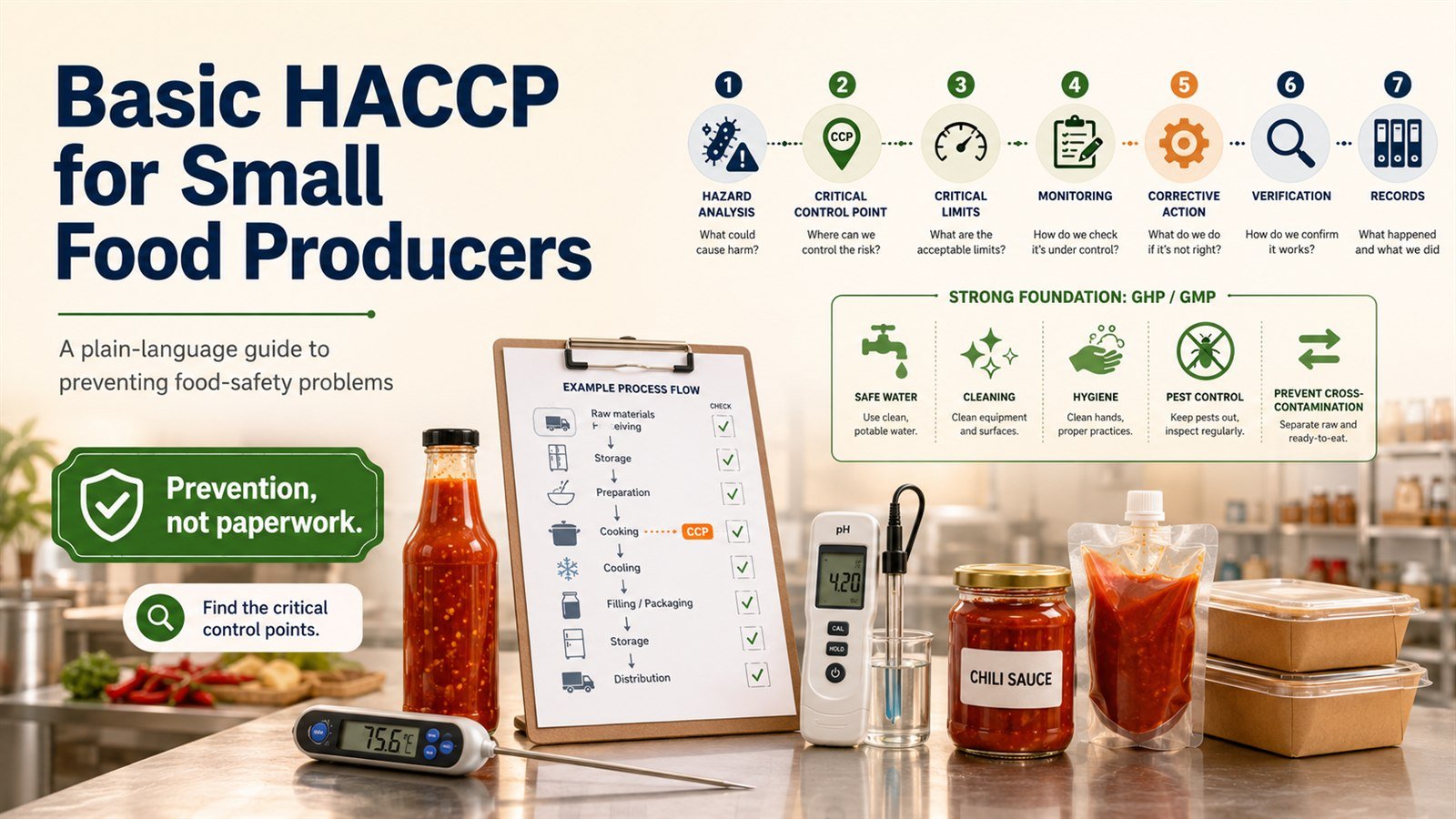
HACCP can sound like something only large factories do, with thick binders, technical language, and outside consultants. But the thinking behind it is practical and can be adapted to a small food business or even a one-person production kitchen. Instead of relying only on finished-product testing, HACCP helps you identify significant hazards and control them at the steps where safety is truly determined. It is a preventive system — not simply paperwork.
Start With Good Hygiene Practices
HACCP does not replace everyday hygiene. Before identifying critical control points, a producer should already have basic controls for safe water and raw materials, cleaning and sanitation, personal hygiene, pest control, equipment maintenance, staff training, and prevention of cross-contamination. These are commonly called Good Hygiene Practices (GHP) or Good Manufacturing Practices (GMP).
HACCP focuses on the significant hazards that still require specific control after these basic practices are working properly.
The Idea in Plain Language
Walk through how your product is made — from receiving ingredients to storage and distribution — and ask what could make someone sick or injured at each step. The hazard may be a harmful microorganism, a cleaning chemical, a pesticide residue, an undeclared allergen, glass, metal, or another foreign material. Then decide how each significant hazard is controlled. Some hazards are managed through good hygiene practices, while others may require a critical control point.
A simple process may have only one or two CCPs, while another process may have more — or none if the significant hazards are adequately controlled by other measures. The number of CCPs should come from the hazard analysis, not from trying to make the plan short.
The Seven Principles, Simplified
- Identify the significant hazards at each step of the process.
- Determine the critical control points where control is essential.
- Set a measurable, scientifically supported critical limit for each CCP — for example, a minimum temperature, minimum processing time, maximum pH, or maximum chilling time.
- Monitor each CCP at the required frequency and record the result.
- Decide in advance what corrective action will be taken when a critical limit is not met.
- Verify that the HACCP system and its controls are working as intended.
- Keep records that show what was monitored, what happened, and what action was taken.
A Small Example
For a bottled chilli sauce, acidification may be an important control step if the hazard analysis confirms it. The producer would use a validated pH limit, measure the product with a calibrated pH meter, and record the result for every batch.
If the critical limit is not met, the batch should be held and managed according to a predetermined corrective-action procedure. A controlled adjustment or reprocessing step may be possible only when an established and validated procedure allows it. The product should not be bottled, released, or sold until its safety has been properly evaluated.
The correct pH target and corrective action depend on the formulation, ingredients, processing method, packaging, storage conditions, and rules of the market where the product will be sold. A controlled acidification step is important, but it does not replace hygiene, sanitation, suitable packaging, or prevention of contamination after processing.
The Short Version
HACCP is a preventive way of thinking about food safety — not unnecessary bureaucracy.
Start with effective hygiene and manufacturing practices. Map your process, identify the significant hazards, determine where control is essential, establish scientifically supported limits, monitor the required batches or production runs, decide in advance what to do when a limit is missed, and keep records that show what actually happened.
Even a small producer can use HACCP thinking. The paperwork can be simple, but the safety decisions must be technically sound.
Important note: This article provides general educational information. A complete HACCP plan should be specific to the product, process, packaging, storage conditions, and target market. High-risk or shelf-stable products should be evaluated by a suitably qualified food-safety professional and supported by appropriate process validation and laboratory testing.