
Food Safety
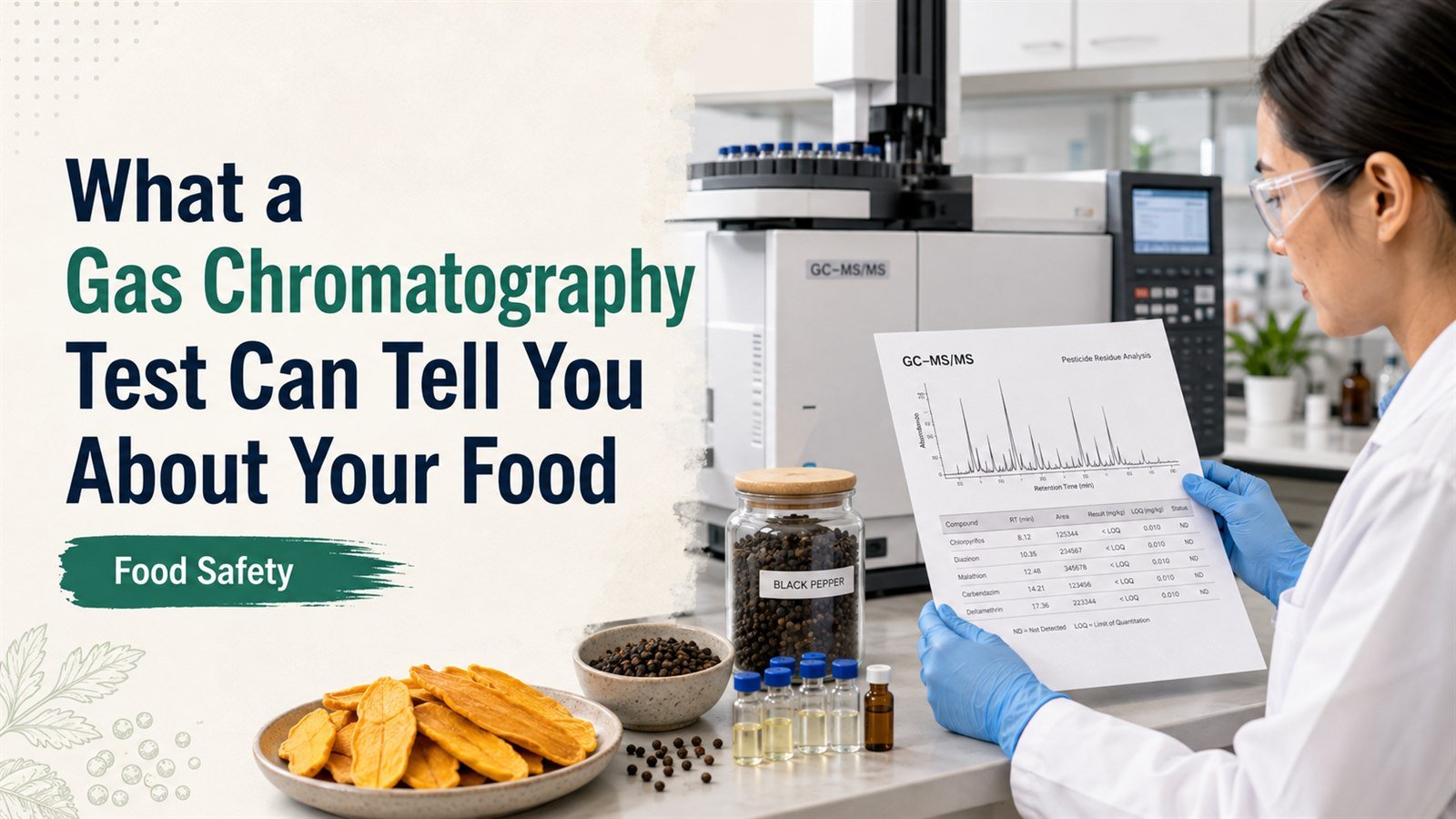
A buyer in Japan or the EU asks for a pesticide residue report before they place an order. You send a sample of your dried mango or your pepper to a laboratory, pay the fee, and two weeks later you get back a page of numbers, a list of chemical names, and a method code like “GC–MS/MS”. Most of the page means nothing to you. This article explains what that machine does, what its report can tell you, and — just as important — what it cannot.
How the machine works
The lab takes a small amount of your product and extracts the compounds of interest into a solvent. A few microlitres of that extract are injected into a hot inlet, where they turn into gas. A carrier gas — usually helium, hydrogen or nitrogen — pushes the gas mixture through the column.
The column is a very thin tube, often 30 m long and 0.25 mm wide, coiled inside an oven and coated on the inside with a thin film. Each compound sticks to that film for a different length of time. A compound that sticks strongly moves slowly. A compound that barely sticks comes out first. The oven is heated on a programme, which pushes the slower compounds along.
At the end of the column sits the detector. A flame ionisation detector (FID) burns whatever arrives and measures how much carbon was in it, so it is good at telling you how much. A mass spectrometer (MS) breaks each compound into fragments and weighs them, so it tells you what the compound is. That is why residue reports usually say GC–MS or GC–MS/MS: the GC part separates, the MS part identifies.
What GC can measure in food
Five uses matter to a small food producer:
- Pesticide residues. One multi-residue screen can look for a few hundred pesticides in a single run. This is the test most export buyers ask for.
- Fat and fatty acid profile, including trans fat. The lab first converts the fats into fatty acid methyl esters, because whole fats are too heavy to travel through a GC column. Then it measures the profile.
- Alcohol and solvent residues. Printed laminate pouches are a real case here. If the printing ink is not dried properly, solvent can stay in the film and move into the food.
- Aroma and off-flavour compounds. If a batch smells of cardboard, paint or old oil, GC can often name the compound that causes it.
- Adulteration of oils. Every oil has a fatty acid pattern. A coconut oil cut with cheaper palm oil shows the wrong pattern.
What GC cannot do
This is the part that costs producers money. GC only works on compounds that turn into gas without breaking down. A great deal of what you might worry about does not:
- Aflatoxins, antibiotics, sugars, most vitamins and most preservatives are too heavy or too fragile. They need liquid chromatography (HPLC or LC–MS).
- Lead, cadmium, arsenic and other heavy metals are elements, not molecules. They need AAS or ICP–MS.
- Bacteria, yeasts and moulds are living organisms. They need a microbiology laboratory, not a chemistry one.
- Water activity, pH, moisture and net weight you measure yourself, with your own meters and scales.
Reading the report
Results come in mg/kg. That is the same as ppm, so 0.01 mg/kg and 0.01 ppm are the same number. You will also see “ND” or “not detected”, and a column headed LOQ.
Then compare each result against the maximum residue limit. Codex sets more than 6,500 of these, and they are set for a pesticide and commodity pair, not for a pesticide on its own. The same pesticide can have one limit on rice, a higher one on mango and a much lower one on a leafy vegetable. Your buyer’s own country may set a stricter limit than Codex.
A worked example: trans fat
Suppose you fry snacks or make bakery products with an imported shortening. WHO advises adults to keep trans fat below 1% of total energy intake, which is under 2.2 g a day on a 2,000 kcal diet. It also recommends that governments cap industrially produced trans fat at 2 g per 100 g of total fat in all foods, or ban partially hydrogenated oils outright. Partially hydrogenated oil is on average 25–45% trans fat.
You cannot see, smell or taste any of that. A fatty acid profile by GC is how you find out what your supplier actually sold you. If you sell into a market that has adopted the 2 g per 100 g cap, that one test decides whether your product can be sold there.
Choosing a laboratory
Ask four questions before you send anything:
- Is the laboratory accredited to ISO/IEC 17025, and does the scope cover this test? Accreditation is granted test by test. A lab can be accredited and still not accredited for pesticides in dried fruit. Ask to see the scope, not just the certificate.
- What is the LOQ for each compound? As above.
- Is this a multi-residue screen or a single-compound method? A screen covers many pesticides at moderate sensitivity. A single-compound method goes lower but only looks for one thing.
- How much sample, and how long? Send too little and the lab cannot repeat the test if something looks odd.
Accreditation matters for export because of the ILAC Mutual Recognition Arrangement, which came into effect in 2001. Accreditation bodies that sign it agree to accept each other’s accredited test data. A report from an accredited lab has a much better chance of being accepted by your buyer’s authorities than one from a lab with no accreditation.
The sample decides everything
A test describes the sample you sent, and nothing else. If you scoop one handful off the top of a sack, the report describes that handful. Take small amounts from several points in the batch, mix them, and send from the mixture. Write the batch code on the sample and keep the same code in your own records. A result you cannot tie back to a specific batch is not much use when a buyer asks a question six months later.
The laboratory does not test your product. It tests the sample you sent, for the compounds you asked about, down to a limit you should have checked first.
The short version
GC separates compounds that turn into gas, and a detector at the end counts or identifies them. In food it is used for pesticide residues, fatty acid and trans fat profiles, solvent residues, aroma compounds and oil adulteration. It cannot see aflatoxins, heavy metals or bacteria.
Before you pay for a test, check the LOQ against the limit your buyer uses, check that the laboratory’s ISO/IEC 17025 scope covers your product, and take a proper sample from across the batch. Those three checks decide whether the report is worth anything.
A free webinar on the machines themselves
If you work in a laboratory, or your workplace is thinking about buying a GC, Agilent is running a free one-hour webinar through Wiley on Wednesday 2 September 2026 at 1:00 PM EDT. That is midnight in Cambodia, so it falls in the early hours of Thursday 3 September here. It covers two new GC systems, the 8890B and the 8860B, and GC Assist, which is software built into the instrument to handle setup and troubleshooting. The speakers are Abbey Fausett, an applications scientist in Agilent’s gas phase division, and Alan Owens, a GC product manager.
References & further reading
- World Health Organization — Pesticide residues in food (fact sheet, 15 September 2022)
- FAO/WHO Codex Alimentarius — Codex Pesticides Residues in Food Online Database (searchable by pesticide and by commodity)
- European Food Safety Authority — Pesticide residues (topic page on EU maximum residue levels)
- World Health Organization — Trans fat (fact sheet, 24 January 2024)
- International Laboratory Accreditation Cooperation — About ILAC (ISO/IEC 17025 accreditation and the ILAC Mutual Recognition Arrangement)