
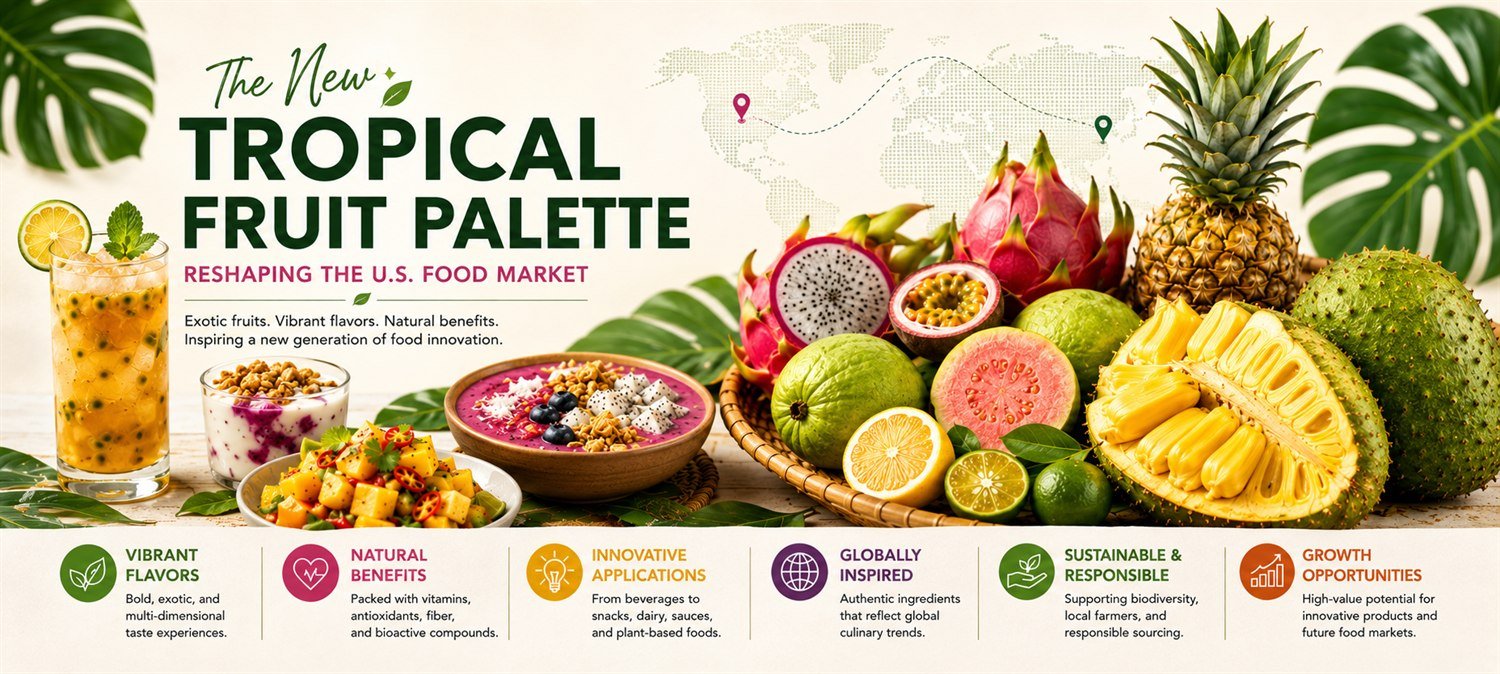
The New Tropical Fruit Palette: How Exotic Fruits Are Reshaping the U.S. Food Market
The U.S. food industry has entered an exciting new chapter where tropical fruits are no longer considered niche ingredients. Once limited to specialty grocery stores and ethnic markets, fruits such as dragon fruit, passion fruit, guava, calamansi, yuzu, jackfruit, and soursop are now appearing in mainstream beverages, dairy products, desserts, sauces, snacks, and even savory dishes.
According to insights from the Institute of Food Technologists (IFT), today’s consumers are increasingly seeking flavors that are vibrant, authentic, naturally functional, and globally inspired. Tropical fruits perfectly satisfy these expectations by offering distinctive sensory experiences while delivering nutritional value and visual appeal.
Consumers Are Looking Beyond Traditional Fruits
For decades, apples, oranges, grapes, and berries dominated the American fruit market. Today, however, consumers—especially Millennials and Gen Z—are becoming more adventurous in their food choices. Social media, international travel, multicultural cuisines, and the growing popularity of global food culture have encouraged people to explore unfamiliar flavors.
Rather than choosing products based solely on sweetness, consumers now appreciate fruits that deliver multiple taste dimensions, including sweetness balanced with acidity, floral aromas, citrus brightness, and complex tropical notes.
This shift has encouraged manufacturers to introduce more diverse fruit ingredients into new product development.
Tropical Fruits Bring Both Flavor and Function
One reason tropical fruits are gaining popularity is their ability to provide more than attractive flavor profiles. Many also contain naturally occurring vitamins, minerals, antioxidants, dietary fiber, and bioactive compounds that align with today’s wellness-focused consumer preferences.
For product developers, tropical fruits offer multiple advantages:
- Unique aroma profiles that differentiate products.
- Natural sweetness and acidity that reduce formulation complexity.
- Bright, appealing colors suitable for clean-label products.
- Opportunities to communicate nutrition and natural ingredients.
As consumers increasingly prefer foods perceived as “naturally healthy,” tropical fruits have become valuable ingredients across multiple food categories.
A New Generation of Flavor Innovation
Manufacturers are no longer using tropical fruits simply as standalone flavors. Instead, they are combining multiple fruits and pairing them with herbs, spices, botanicals, fermented ingredients, and dairy alternatives to create sophisticated sensory experiences.
Examples include:
- Mango with chili and lime
- Pineapple with ginger
- Passion fruit with hibiscus
- Guava with coconut
- Dragon fruit with citrus
- Calamansi in sparkling beverages
- Jackfruit in plant-based meat alternatives
These combinations create products that feel fresh, globally inspired, and highly differentiated in competitive markets.
Sustainability Is Also Driving Interest
Consumers increasingly care about where ingredients come from and how they are produced. Tropical fruits often support stories around biodiversity, regional agriculture, smallholder farmers, and sustainable sourcing.
Food companies are therefore using tropical ingredients not only for their flavor but also for their ability to communicate authenticity and environmental responsibility.
Transparent sourcing and responsible supply chains have become additional selling points for tropical fruit-based products.
Opportunities for Food Scientists and Product Developers
For food scientists, the growing popularity of tropical fruits presents exciting opportunities for innovation.
Developing successful products requires understanding:
- Flavor chemistry and aroma compounds
- Processing effects on color and volatile compounds
- Shelf-life stability
- Ingredient interactions
- Consumer sensory perception
- Sustainable ingredient sourcing
Advances in food science and predictive modeling now enable researchers to optimize processing conditions while preserving the characteristic aromas and nutritional qualities of tropical fruits.
Why This Matters for Tropical-Producing Countries
Countries rich in tropical biodiversity—including Cambodia, Thailand, Vietnam, the Philippines, Indonesia, and many Latin American nations—are well positioned to benefit from these changing consumer preferences.
Rather than exporting only fresh fruit, producers can create higher-value products such as premium juices, functional beverages, fruit powders, frozen products, sauces, snacks, fermented products, and natural flavor ingredients.
This transition from commodity production to value-added innovation offers significant economic opportunities for local food industries.
Looking Ahead
The emergence of a new tropical fruit palette reflects more than a changing flavor preference—it represents a broader transformation in consumer expectations.
Modern consumers seek foods that are authentic, nutritious, visually appealing, globally inspired, and environmentally responsible. Tropical fruits naturally meet these expectations, making them one of the most promising ingredient categories for future food innovation.
For food scientists and the food industry, the challenge is no longer introducing tropical fruits to consumers. The opportunity now lies in unlocking their full potential through science, technology, and creative product development.
Reference
This article summarizes insights from: Brewster, E. (2026, July/August). The New Tropical Fruit Palette. Food Technology Magazine, Institute of Food Technologists (IFT). https://www.ift.org/food-technology-magazine/the-new-tropical-fruit-palette