
Starting a Food Business
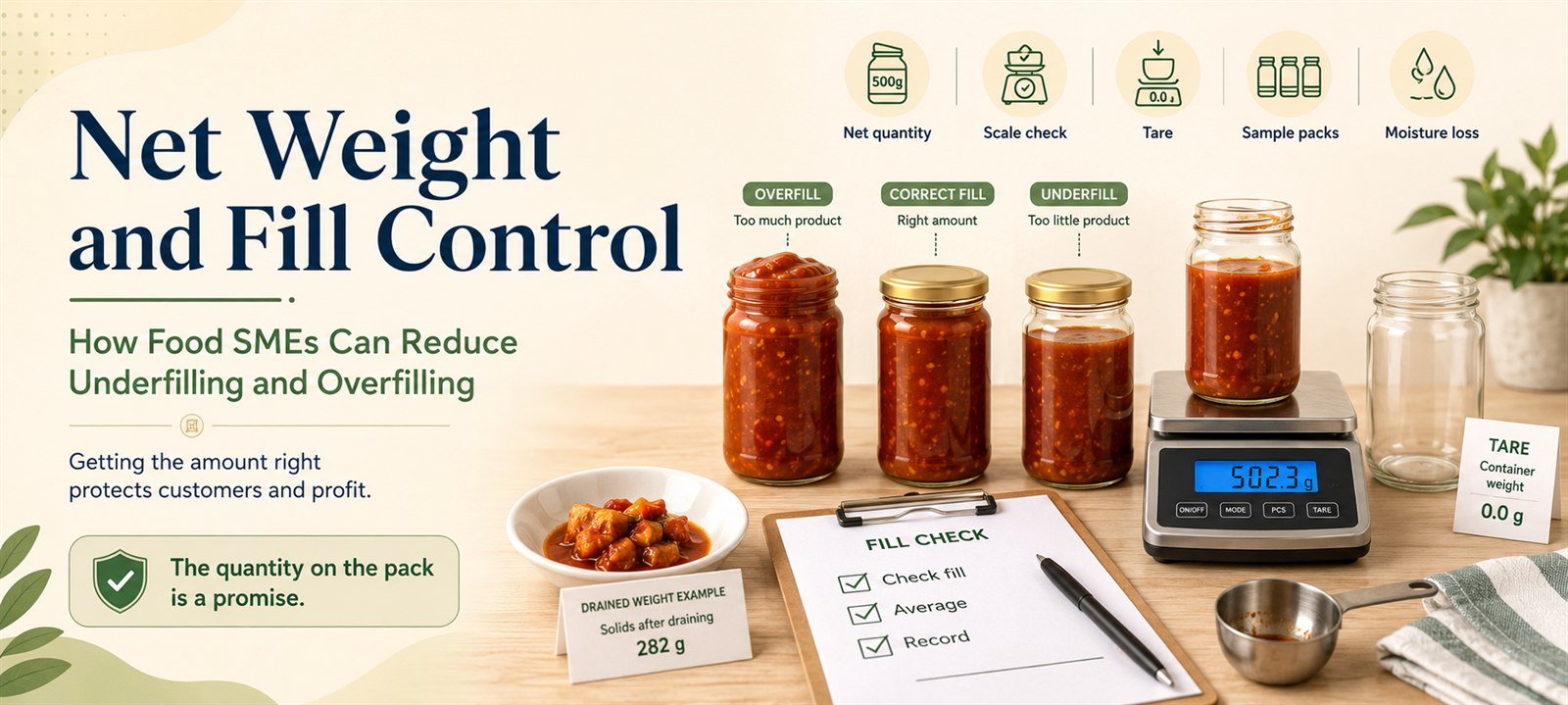
The quantity printed on your package is two things at once: a promise to the customer and a legal declaration. Put “200 g” on the label and your filling process should be controlled so that the average quantity meets or exceeds 200 g, while individual packs remain within the permitted limits for your market. Fill too little and you risk misleading customers and attracting regulatory action. Fill too much and you quietly give away profit, gram by gram, on every unit you sell.
Why both underfilling and overfilling hurt
Consistent underfilling can mislead customers, damage retailer relationships, reduce trust, and lead to regulatory action. Overfilling is less visible, but it creates a steady loss in margin. The goal is not to hit one exact number every time — especially when filling by hand — but to keep the average at or above the declared quantity and control how widely individual packs vary.
Example: If a sauce is labelled 200 g but the average fill is 207 g, the extra 7 g may seem small. Across 10,000 jars, however, the business gives away 70 kg of product without payment.
Getting fills consistent
- Calibrate or verify your scale regularly using a known reference weight. An inaccurate scale makes every other control unreliable.
- Tare the empty container so you measure only the food, not the jar, bottle, tray, or lid.
- Check several packages at the beginning, middle, and end of production. Record the individual results and calculate the average. Watch for drift — a filler may gradually deliver more or less product as temperature, viscosity, pressure, or operator technique changes.
- Allow for expected weight changes. Some products lose moisture after packing, so the target fill should account for changes during storage and distribution. Check whether your market allows any specific tolerance for normal moisture loss.
The label and the contents must agree
The declared quantity must match what is actually inside, measured in the way required for that product. Liquid foods may be declared by volume, while solid foods are usually declared by weight. For foods packed in brine, syrup, or another liquid medium, the label may need to show both net quantity and drained weight.
Do not assume that one rule applies to every product. Requirements may evaluate the average quantity of a production lot as well as shortages in individual packages. Confirm the current rules for Cambodia or for the export market before finalising the label and target fill.
The short version
The quantity printed on a package is a promise to the customer.
Good fill control means using a suitable scale, taring the package, checking samples throughout production, allowing for expected product changes, and keeping useful records. The goal is not uncontrolled overfilling or risky underfilling — it is a stable process that protects customers and the business.
This article provides general educational information and is not a substitute for legal or metrology advice. Requirements differ by country, food category, package type, and market. Always verify the current rules that apply to your product.
References & further reading
- Consumer Protection & Competition Directorate-General (Ministry of Commerce, Cambodia) — Laws
- Consumer Protection & Competition Directorate-General (Ministry of Commerce, Cambodia) — Prakas (ministerial regulations)
- OIML (International Organization of Legal Metrology) — R 87: Quantity of product in prepackages (PDF)
- FAO/WHO Codex Alimentarius — General Standard for the Labelling of Prepackaged Foods (online text)