
Processing
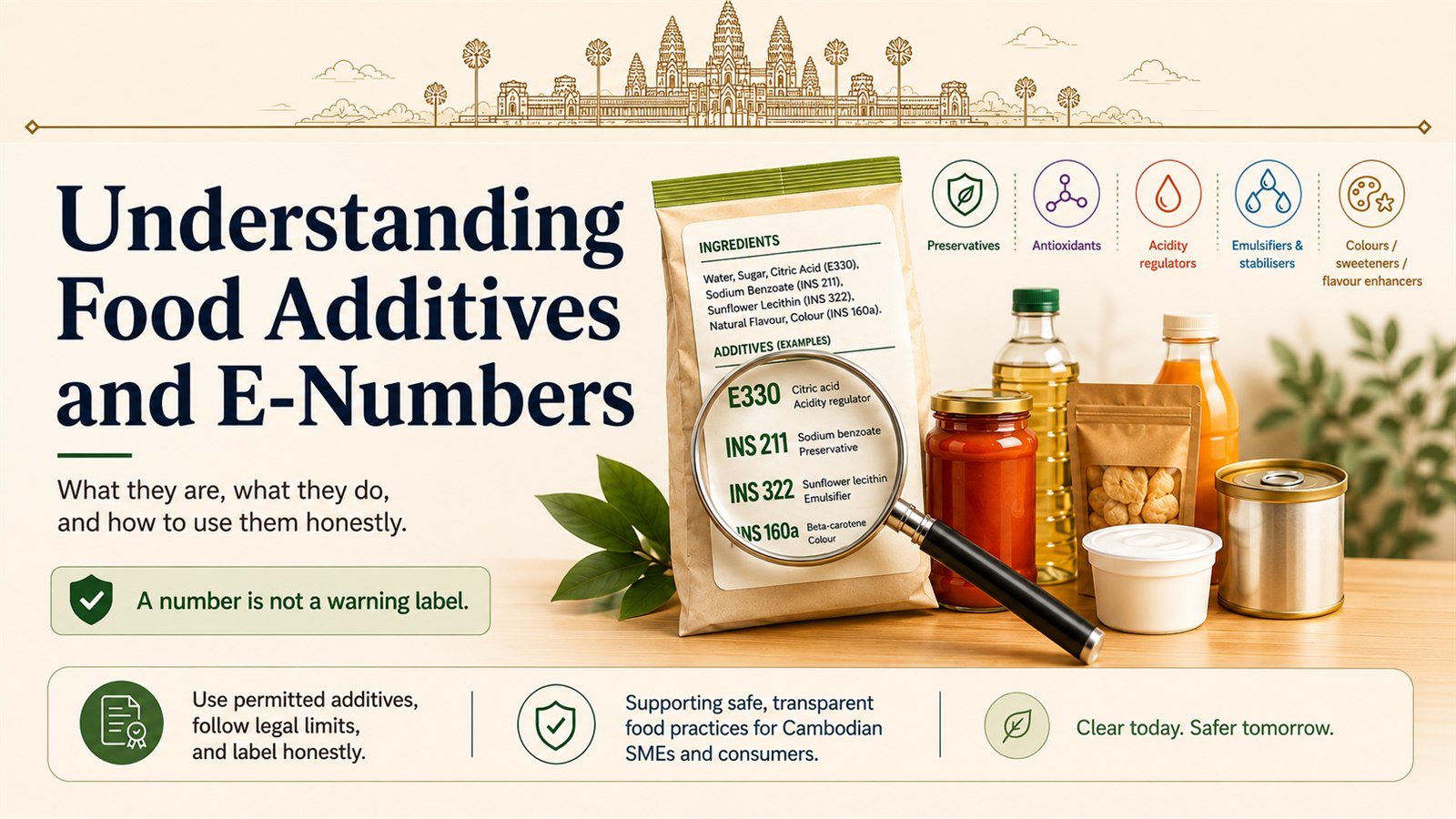
Read the back of almost any packaged food and you will find codes like “E330” or “INS 211”. To many shoppers they look like chemistry no one should eat. In reality they are just a naming system — a shorthand so that the same additive has one recognised code in every language. Understanding what additives do, and why they are numbered, takes the fear out of the ingredient list and helps you formulate honestly.
What additives are for
Additives are grouped by the job they do, not by whether they sound natural. The main families are:
- Preservatives — help slow spoilage by controlling the growth of certain microorganisms.
- Antioxidants — slow oxidation that can make fats and oils rancid or cause colour changes.
- Acidity regulators — adjust or maintain acidity and pH.
- Emulsifiers and stabilisers — help ingredients remain evenly mixed and keep texture consistent.
- Colours, sweeteners, and flavour enhancers — shape how the product looks and tastes.
The number is not a warning label
An INS or E-number does not automatically mean a substance is artificial or unsafe. Some numbered additives are familiar substances: ascorbic acid, also known as vitamin C, is identified as E300, while citric acid, which occurs naturally in citrus fruits, is identified as E330 when it is used as an additive. The number identifies the substance; it is not, by itself, proof of approval for every use. Whether an additive can be used depends on the rules for the specific market, food category, technological purpose, and amount.
“Clean label” is a choice, not a rule
Many producers now aim for a short, familiar ingredient list — often described as “clean label” — because some customers prefer it. That is a valid product and marketing choice, but it does not automatically make a product safer or better. The honest options are clear: use permitted additives correctly and declare them, or reformulate so the product genuinely works without them. What is not acceptable is using additives while hiding them from the ingredient list.
Additives cannot fix a poor process
An additive is only one part of a food-control system. It cannot replace clean raw materials, good hygiene, correct pH, controlled heating, suitable packaging, or shelf-life testing. If a product spoils, adding more preservative without identifying the real cause may increase legal and quality risks without solving the problem.
The short version
E-numbers and INS numbers are identification systems, not danger symbols and not automatic permission for use.
Each additive has a technological function, but whether it may be used depends on the food category, purpose, amount, market, and labelling rules. For SMEs, the responsible approach is simple: understand why the additive is needed, verify that it is permitted, use only the necessary amount, control the complete production process, and declare it honestly. Treat “clean label” as a formulation and marketing option, not a moral rule.
References & further reading
- European Commission — EU rules on food additives
- European Commission — Food additives (overview)
- European Commission (EGTOP) — Expert group report on food (PDF)
- FAO/WHO Codex Alimentarius — General Standard for Food Additives (GSFA)
- World Health Organization — Food additives (fact sheet)