
Processing
A practical guide to improving product consistency for food SMEs.
You produce one batch of sauce, juice, snack, jam, or spread, and it turns out perfectly. The colour looks right, the texture is good, and customers enjoy the taste.
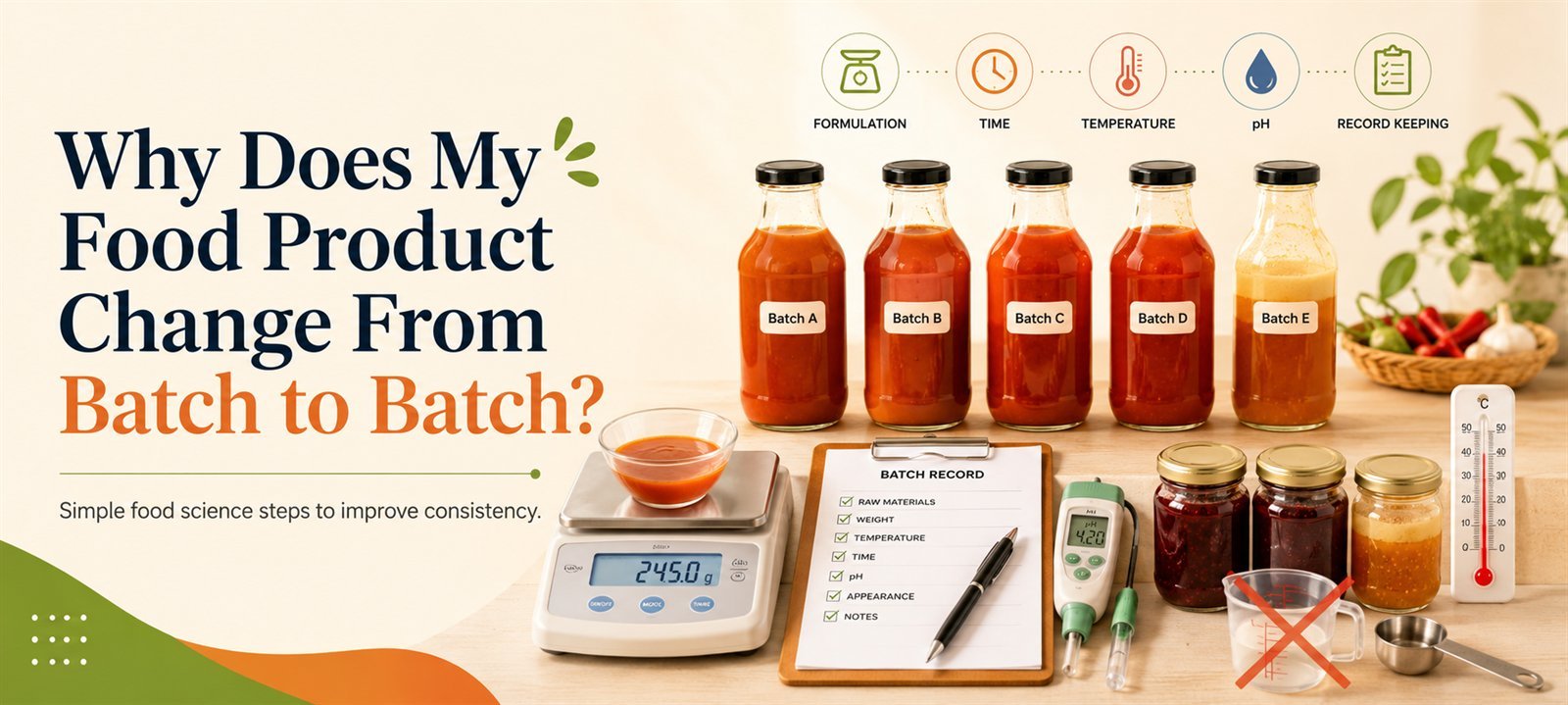
Then you make the same product again — but something has changed. The next batch may be thinner, darker, sweeter, saltier, more acidic, or less aromatic. A sauce may separate during storage, a drink may form sediment, or a snack may lose its crispness.
For many food SMEs, this is a common challenge. The good news is that batch variation is rarely random. It usually comes from differences in raw materials, measurements, processing conditions, equipment, or production practices.
A consistent product does not depend on luck or one experienced worker’s memory. It depends on a standardised formulation, a controlled process, and useful production records.
Why Consistency Matters
Customers expect the product they buy today to be similar to the one they bought before. Small natural differences may be acceptable, especially for products made from fruit, vegetables, herbs, or other agricultural materials. However, large and unexplained variations can reduce customer confidence.
Inconsistent production can also cause:
- Customer complaints
- Product returns
- Shorter shelf-life
- Higher production losses
- Difficulty entering supermarkets
- Problems during business expansion
Consistency is therefore not only a quality issue. It is also important for business growth.
Standardize the Formulation
Many small businesses begin with family recipes or kitchen-scale trials. Instructions may include phrases such as “Add a little salt,” “Use two cups of sugar,” or “Cook until it looks thick.”
These instructions may work when one person makes a small quantity, but they become unreliable when production increases or another worker takes over.
A standardised formulation is an official recipe in which every ingredient is measured accurately and every important production step is clearly defined. It should list each ingredient using an exact weight and show its percentage of the total formula.
| Ingredient | Weight | Percentage |
|---|---|---|
| Fruit pulp | 60 kg | 60% |
| Water | 20 kg | 20% |
| Sugar | 15 kg | 15% |
| Other ingredients | 5 kg | 5% |
| Total | 100 kg | 100% |
Each percentage represents the ingredient’s share of the total batch weight. Percentages make it easier to produce different batch sizes without changing the product balance.
Use Weight Instead of Informal Volume Measurements
Cups, spoons, bowls, and handfuls may seem convenient, but they can create variation. One spoon may be level while another is heaped. Powders may become compacted, and different workers may fill the same cup differently.
This is especially risky for ingredients used in small quantities, such as acids, preservatives, gums, colours, and flavours.
| Avoid | Use instead |
|---|---|
| Add one spoon of citric acid. | Add 12 grams of citric acid. |
The scale must suit the quantity being measured. A floor scale may be suitable for 50 kilograms of fruit, but it may not accurately measure 10 grams of preservative. Small-quantity ingredients require a more sensitive scale.
Prepare a Master Formulation
A master formulation is the approved recipe used for production. It should include:
- The name, exact weight, and percentage of every ingredient
- The approved supplier or ingredient type
- The intended batch size
- The order of addition and special preparation instructions
- The formulation version and approval date
Only the approved version should be used. Any change should be tested, approved, and recorded before it becomes part of the official formulation.
Control Raw-Material Quality
Even when the recipe stays the same, raw materials may change. Fruit sweetness and acidity vary with variety, ripeness, season, storage, and supplier. Coconut milk may vary in fat content, chilli may differ in pungency, and flour or starch may absorb different amounts of water.
Create simple raw-material specifications that define what is acceptable. Focus on the characteristics that most strongly affect your product, such as:
- Supplier or variety
- Ripeness and appearance
- Absence of damage or mould
- Storage condition and maximum storage time
- pH, acidity, or °Brix when relevant
For example, two batches of mango sauce may use fruit with different maturity. Ripe mangoes may be sweeter and less acidic than less-ripe fruit. Even when the same sugar level is added, the final taste can change. Measuring °Brix and acidity before production can help you decide whether a controlled adjustment is needed.
You do not need to test everything. Select the few measurements that give useful information about your most important raw materials.
Control Processing Time and Temperature
Using the same ingredients does not guarantee the same result when the process changes. Cooking a sauce for longer removes more water, making it thicker, darker, and more concentrated. It may taste sweeter or saltier even though the formulation has not changed.
Important processing conditions may include:
- Heating temperature and cooking time
- Mixing time, speed, and order of ingredient addition
- Cooling time and filling temperature
- Drying or frying conditions
Avoid instructions such as “cook until ready” or “mix until smooth” without measurable guidance. A reliable thermometer, timer, scale, pH meter, or refractometer can improve control without requiring an expensive laboratory.
Keep a Batch Production Record
A batch record shows what happened during each production run. It may include:
- Production date, batch code, and operator
- Ingredient quantities and raw-material lot numbers
- Processing times and temperatures
- pH, °Brix, or other selected quality results
- Final yield, package count, and any adjustments
When a batch turns out differently, these records help you compare it with a successful batch. Without records, the business must depend on memory and guesswork.
Define Acceptable Quality Ranges
A product does not need to be perfectly identical every time, but it should remain within a defined and acceptable range.
A simple finished-product specification may include appearance, colour, aroma, taste, texture, pH, °Brix, viscosity, net weight, package condition, and the absence of separation or sediment — depending on the product.
Instead of saying a sauce should be “slightly acidic,” define an acceptable pH range. Instead of saying a bottle should be “full,” define the target filling weight and allowed variation.
Start With Three Simple Changes
- Weigh every ingredient accurately.
- Record important processing times and temperatures.
- Check the finished product against a few defined quality targets.
After several batches, review the results. You may find that thinner products are linked to shorter cooking times, darker colour to excessive heating, or variable taste to raw materials with different maturity levels.
Final Message
Product consistency is not achieved simply by asking workers to be more careful. It comes from creating a system that makes the correct method clear, measurable, and repeatable.
A standardised product depends on an approved formulation, controlled raw materials, defined processing conditions, acceptable quality ranges, and reliable production records.
A good recipe may create one successful batch. A controlled process helps create a successful product again and again.